
energypop Logo Energypop Contact Us
Contact Us

The History You'll See Along the Way

A brief guide to what you're actually looking at — from the cathedral to the abbey ruins. Understanding the history makes the walk much more rewarding.

10 min read All Levels June 2026
Síle O'Donnell, Senior Heritage Access Specialist

Síle O'Donnell

Senior Heritage Access Specialist

Heritage access specialist with 14 years' experience designing inclusive walking routes at Irish ecclesiastical sites, including Rock of Cashel and Hore Abbey.

01. What You're Walking Through

The Rock of Cashel isn't just one building. It's a complete ecclesiastical settlement that evolved over 1,300 years. When you're walking the grounds, you're moving through layers of history — literally. The oldest stones you'll see date back to the 10th century. The most recent structures are from the 1700s.

Here's the thing: most people visit and wonder what they're looking at. That's completely normal. But once you understand the basics, the whole site comes alive. You'll start noticing details you'd otherwise walk past.

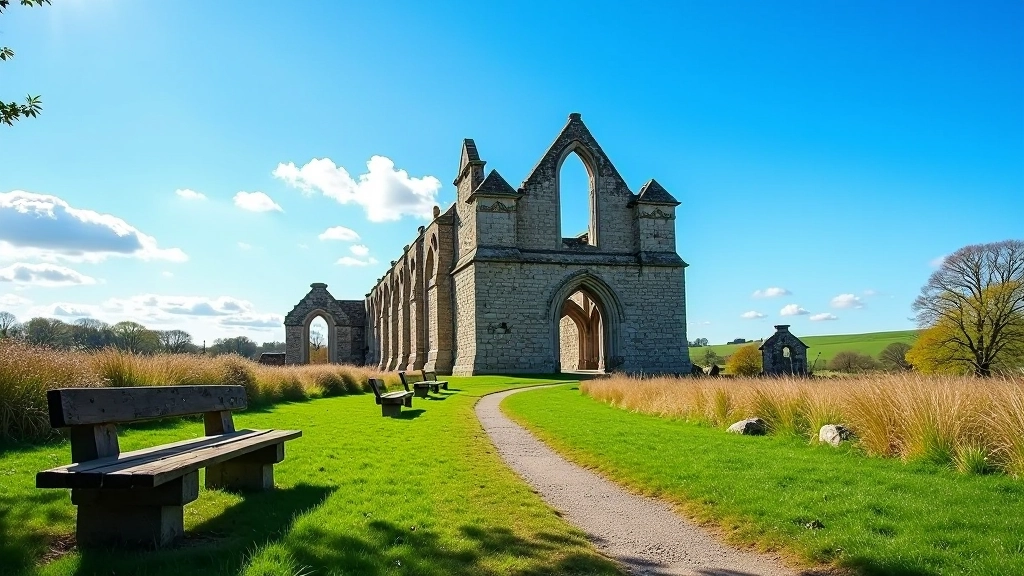
Historic stone cathedral with towering walls and archways, showing the weathered remains of centuries-old architecture

02. The Cathedral — The Main Event

The cathedral is the largest structure on the rock. You can't miss it — it's the building with the impressive stone walls and Gothic-style windows. Most of what you see was built between the 13th and 15th centuries, though there was a church on this spot much earlier.

The interior is open and surprisingly spacious. Climb up inside if you can — the views from the top are worth it. You'll notice the walls are incredibly thick (roughly 2-3 metres in places). That's because they weren't just protecting a place of worship. They were protecting people. Medieval fortifications and spiritual spaces often went hand in hand.

Look at the stonework up close. You'll see tool marks from medieval masons. Some stones have crosses carved into them — markers that different workers made. It's a direct connection to people who lived 600 years ago.

Educational Information

The historical details and architectural descriptions in this guide are provided for educational purposes based on documented records and archaeological research. While we've made every effort to be accurate, historical interpretations can vary. For detailed academic information, we recommend consulting the official Rock of Cashel heritage centre or published archaeological studies. Always check current accessibility conditions before your visit.

03. The Round Tower — A Mystery That Isn't

You'll spot the round tower pretty quickly. It's the tall, cylindrical stone structure that stands about 28 metres high (roughly 92 feet). People often ask: what's it for? Was it a bell tower? A watchtower? A refuge during raids?

The honest answer is that historians don't know for certain. But the leading theory suggests it was built around the 10th century as a bell tower and possibly as a refuge. During times of danger, monks could retreat inside and pull up the ladder — there's only one entrance, and it's about 3.5 metres up the wall.

The real value in seeing it? Understanding scale. Standing at the base and looking up gives you a sense of how people in the medieval period thought about space and security. The tower still has its original conical roof, which is remarkable given its age.

04. Hore Abbey — The Secondary Site

If you're doing the extended walk (and we'd recommend it), you'll head down to Hore Abbey. It's about a 20-minute walk from the main rock, and it feels like stepping into a completely different world. The abbey is set in open fields, surrounded by green meadows. On a clear day, the views back up to the rock are stunning.

Hore Abbey was founded in the 13th century and was inhabited by Cistercian monks until the 1540s. What you're looking at now are ruins — the abbey church, some cloister remains, and parts of the refectory. Unlike the cathedral, which is relatively intact, Hore Abbey is fragmentary. That can actually be more interesting because you have to use your imagination to reconstruct what stood there.

The ruins sit about 15 metres above the surrounding field, on a slight rise. This wasn't accidental — monasteries were built with access to water and views for defense. The ruins are well-maintained but unprotected, so you can walk right up to the stones. It's a much more intimate experience than the main site.

05. Timeline — What Happened When

Understanding the timeline helps everything make sense. Here's the condensed version:

5th century

St. Patrick (or someone associated with him) is said to have visited and established a settlement here. This is more legend than documented history.

10th-12th centuries

The round tower, the earliest stone structures, and basic fortifications are built. The rock becomes an important religious and defensive site.

13th-15th centuries

The cathedral and other major stone structures are constructed. The site reaches its architectural peak.

16th century onwards

Religious dissolution, changing fortunes, and eventually the site becomes a historical monument rather than an active religious centre.


What to Look For During Your Walk

Stone Patterns

Look at how different walls are built. Older stones are often irregularly shaped. Newer construction is more uniform. This tells you the age of what you're looking at.

Window Styles

Gothic windows (pointed arches) are later than Romanesque (rounded arches). The cathedral has both — you can see the timeline in the stonework.

Defensive Features

Notice the narrow windows and thick walls. These weren't built for comfort — they were built for protection. This was a fortress first, a church second.

Ground Level

Look at the ground around buildings. You'll often see foundation outlines and changes in soil colour that show where structures once stood.

Making the Most of Your Visit

The Rock of Cashel isn't a quick photo stop. It's a place that rewards curiosity and time. You'll get more out of it if you're not rushing. Spend time sitting near the cathedral just observing. Notice how the light changes the colours of the stone throughout the day. Think about the thousands of people who've stood in this same spot over the past 1,000 years.

Walking these grounds connects you to real history — not a sanitized version, but the actual stones where people lived, prayed, worked, and survived. That's what makes it special.